Days instead of weeks
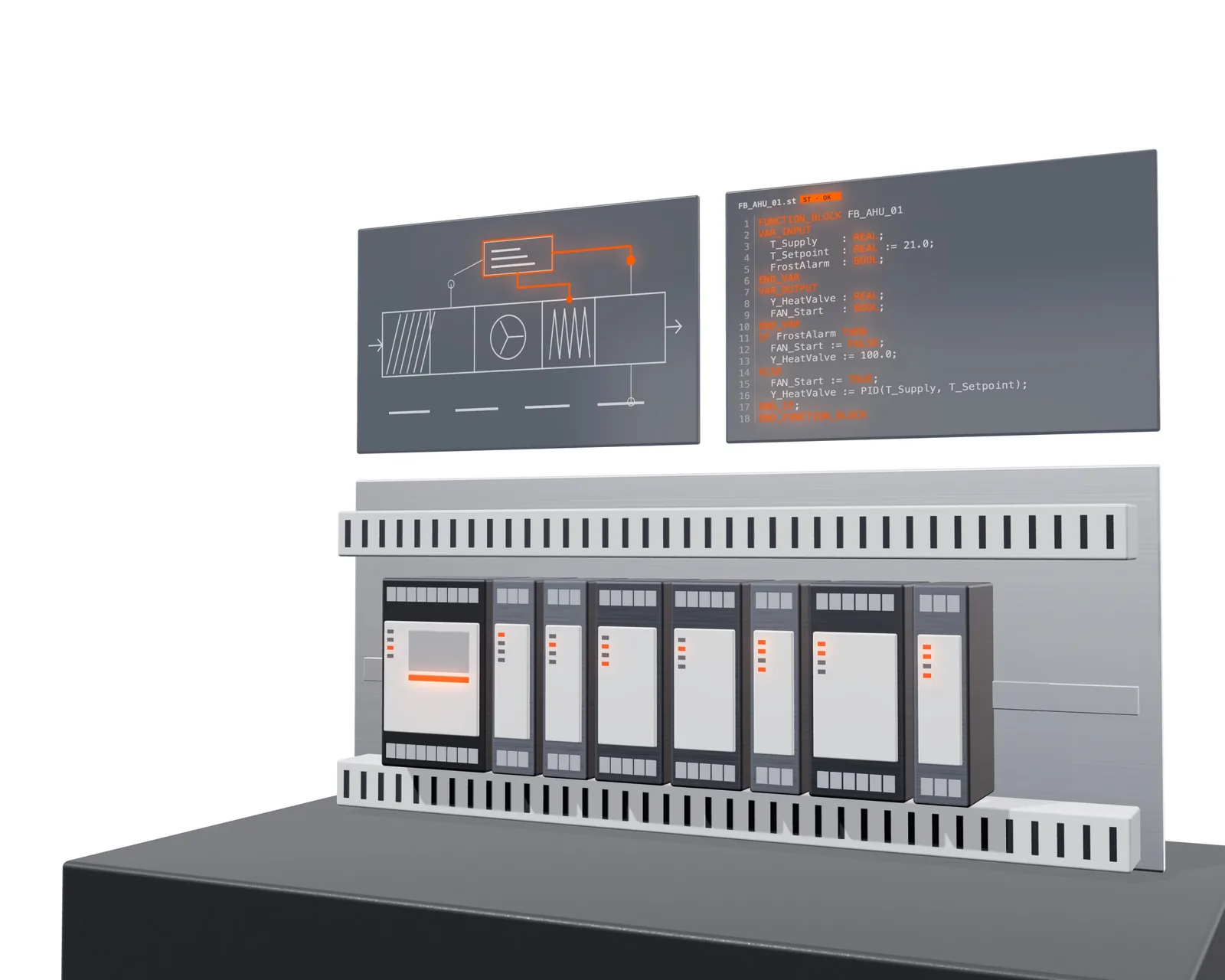
The program for an air-handling unit comes from the description, not from scratch. The engineer reads and approves, not writes.
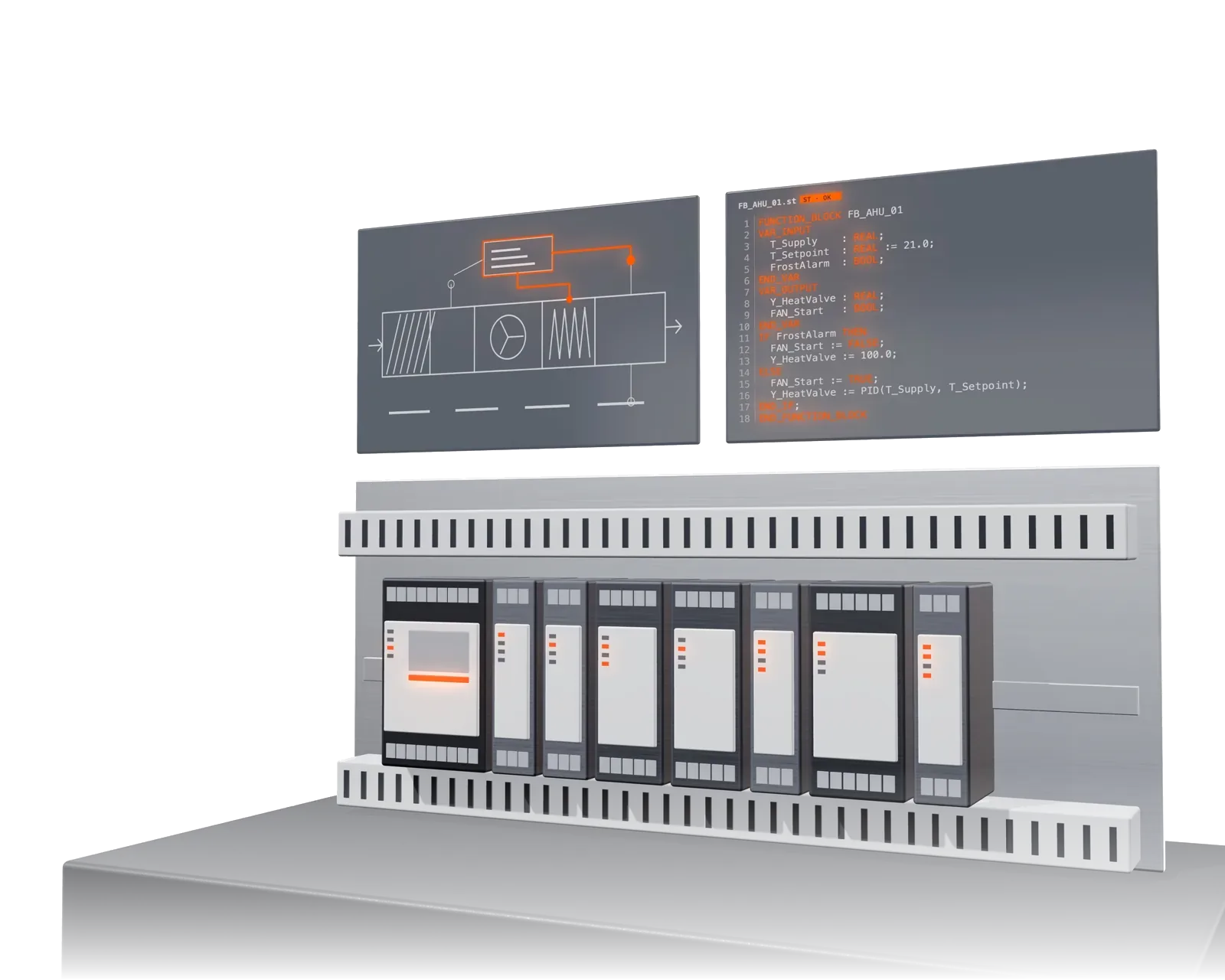
PLC control software is created automatically from the technology description of the equipment. AI assembles code to the IEC 61131-3 standard (Structured Text), e.g. for CoDeSys, from verified solution libraries. The engineer checks and approves the code, then it goes into the PLC.
The program for an air-handling unit comes from the description, not from scratch. The engineer reads and approves, not writes.
Points, tags and sequences come from the same description as the drawings and BMS. Nothing is retyped by hand.
Solution libraries and program blocks are verified and repeatable. Know-how stays in the company.
AI generates code in Structured Text according to IEC 61131-3. Where the ST implementation is complete, you open the program in the platform's development environment and load it into the PLC without rewriting. Systems built on graphical blocks (FBD, Sedona, proprietary macros) need a translator into their blocks. Overview by country:
Beckhoff CX, WAGO PFC / CC100, DEOS AG (OPEN EMS), Phoenix Contact PLCnext, ABB AC500, LOYTEC, B&R, SIGMATEK, SBC QronoX, Selectron Systems, Teco, Unipi, Domat, Schneider Modicon, Eliwell, Elsist, Exor, Pixsys, Eurotherm (Watlow)
Saia Burgess Controls (SBC), AMiT, InVentia (MT rada)
Sauter (modulo 5/6), Siemens BT (Desigo), iSMA CONTROLLI, Schneider SpaceLogic, Distech Controls, Carel, Trend (Honeywell), Cylon (ABB), Tridium EMEA
Where the BMS controller does not support IEC 61131-3 ST (Sauter, Siemens Desigo, Trend, SpaceLogic, Distech, Carel), the generated code is not deployed into it but into an ST controller next to it. The BMS communicates with it via standard BACnet.
Advantage: 100 % reliability of deterministic execution, independence from CASE Suite or ABT licences and the ability to deploy any ST logic including OOP classes. The BMS keeps the visualisation, alarms and trends, which it reads from the same BACnet objects.
Automatically generated code for buildings with Sauter CASE Suite:
When Desigo PXC (e.g. PXC4 / PXC7) is specified for the site together with ST code execution:
| Manufacturer / platform | Development environment | IEC 61131-3 ST | Native BMS protocols | Primary application area | Direct use of code |
|---|---|---|---|---|---|
| Beckhoff CX | TwinCAT 3 (Visual Studio) | Full (OOP ST, inheritance) | BACnet B-BC, DALI-2, KNX, M-Bus, SMI | Complex smart buildings, hospitals, data centres | ✓Direct; ST variables are linked to I/O and BACnet objects |
| WAGO PFC / CC100 | CODESYS V3.5 / e!COCKPIT | Full (CODESYS standard) | BACnet B-BC, DALI-2, KNX TP1, EnOcean | HVAC plant rooms, boiler rooms, zone lighting control | ✓Direct |
| DEOS AG (OPEN EMS) | OPENproject (CODESYS) | Full (native ST) | BACnet B-BC, Modbus RTU/TCP, KNX | Education, hotels, public buildings, pure HVAC | ✓Direct |
| Phoenix Contact PLCnext | PLCnext Engineer | Full (+ C++/Python/Docker) | BACnet, Modbus, DALI libraries | Hybrid IoT/BMS installations, infrastructure | ✓Direct |
| ABB AC500 | Automation Builder | Full | BACnet, Modbus, gateways for KNX/DALI | Industrial buildings, energy centres | ✓Direct |
CODESYS and TwinCAT 3 are globally the most suitable targets for generated ST: WAGO, Beckhoff and DEOS consume the code directly and variables are linked to hardware I/O and BACnet objects.
| Manufacturer | Product range | Development environment | IEC 61131-3 ST | BMS buses (BACnet, DALI, KNX, M-Bus) | Typical deployment in practice | Direct use of code |
|---|---|---|---|---|---|---|
| LOYTEC | L-IOB, L-ROC, L-INX | L-STUDIO / L-LOGICAD | Full (ST + IEC 61499) | Complete native integration at CPU level | Commercial buildings, hotels, zone control and HVAC plant rooms | ✓Direct |
| B&R | X20, Automation PC, APROL | Automation Studio | Full (including OOP ST) | BACnet/IP, Modbus, M-Bus cards, gateways | Data centres, pharmaceutical sites, cleanrooms | ✓Direct |
| SIGMATEK | S-DIAS system | LASAL | Full (object-oriented ST) | Modbus, OPC UA, optional BACnet | Control of plant rooms, HVAC | ✓Direct |
| Manufacturer / platform | HQ in Switzerland | Engineering software | IEC 61131-3 ST support | BMS protocols on the CPU | Suitability for automatic ST code generation |
|---|---|---|---|---|---|
| Saia Burgess Controls (SBC) | Murten | PG5 Controls Suite | Yes (built-in IEC editor) | BACnet/IP (B-BC), S-Bus, Modbus RTU/TCP, M-Bus | ◐Medium to good: the PCD data model must be followed and I/O assigned |
| SBC QronoX | Murten | QronoX Pro / Web IDE | Yes (modernised ST) | BACnet/IP, OPC UA, MQTT, Modbus | ✓High for modern modularised applications |
| Sauter (modulo 5/6) | Basel | CASE Suite | No (closed FBD) | BACnet/IP, BACnet/SC, Modbus | ✕Not suitable: code requires translation into proprietary blocks |
| Siemens BT (Desigo) | Zug | ABT Site / ABT Pro | No (CFC / D-MAP) | BACnet B-BC, KNX PL-Link, Modbus | ✕Not suitable for direct ST import |
| Selectron Systems | Lyss | CAP1131 | Full (pure ST) | CANopen, Ethernet/IP, Modbus | ✓High, but limited to specific infrastructure |
The only native Swiss BMS player with ST is Saia Burgess Controls (PCD / PG5): ST compiles directly into the CPU, but the address space of SBC media (registers, flags) must be respected. Sauter and Siemens Zug do not support IEC 61131-3 ST; their engineering is based on certified graphical macros tied to the BACnet object structure. Solution: an ST controller alongside, linked via BACnet objects, see above.
| Manufacturer | Product range | Development environment | IEC 61131-3 ST | BACnet support | Focus in practice | Direct use of code |
|---|---|---|---|---|---|---|
| Teco | Tecomat Foxtrot 2 | Mosaic | Full (native) | Yes (BACnet/IP) | Comprehensive building automation, HVAC, zone control (CIB) | ✓Direct |
| Unipi | Patron / Axon | Mervis IDE / CODESYS | Full | Yes (Mervis BACnet server) | IoT gateways, HVAC plant rooms, OEM control | ✓Direct |
| Domat | markMX, wPLC | Merbon IDE | Full (ST + FUPLA) | Yes (BACnet/IP B-BC) | Primarily building services / HVAC, heat substations, AHUs | ✓Direct; the graphical part (FUPLA) is completed in Merbon IDE |
| AMiT | AMiNi4/5, AMR-CP | DetStudio | Own ST dialect (not strict IEC) | Not native on the PLC (requires a gateway) | Traditional controls (boiler rooms, HVAC), local supervisory stations | ◐Code is adapted to the DetStudio dialect before loading; BACnet via a gateway |
| Manufacturer / platform | Development environment | IEC 61131-3 ST | Native BMS protocols | Primary application area | Direct use of code |
|---|---|---|---|---|---|
| iSMA CONTROLLI | iSMA Tool (Sedona) / Niagara | No (Sedona FBD / Java) | BACnet/IP, Modbus, DALI, M-Bus | Air-handling units, zone fan coils, peripheral integration | ✕Via a translator into Sedona blocks |
| InVentia (MT rada) | MTData / IEC compiler | Partial / specific models | Modbus RTU/TCP, M-Bus, MQTT | Heat substations, building telemetry | ◐Only models with the IEC compiler |
Native Polish BMS platforms are built on graphical Sedona FBD. Direct ST deployment in Poland is handled with German hardware running CODESYS.
| Manufacturer / platform | Development environment | IEC 61131-3 ST | Native BMS protocols | Primary application area | Direct use of code |
|---|---|---|---|---|---|
| Schneider Modicon | EcoStruxure Machine Expert | Full (CODESYS core) | Modbus, Ethernet/IP, BACnet gateways | Large chiller plant rooms, industrial building services | ✓Direct |
| Schneider SpaceLogic | EcoStruxure Building Operation | No (Script / FBD) | BACnet B-BC, LonWorks, Modbus, KNX | Commercial office buildings (classic BMS) | ✕Via a translator into Script / FBD |
| Distech Controls | EC-gfxProgram / ENVYSION | No (graphical FBD / Python) | BACnet B-BC, LonWorks, EnOcean | Commercial spaces, modern zone control | ✕Via a translator into graphical FBD |
Native French BMS platforms (SpaceLogic, Distech) are built on graphical component programming or scripts. Direct ST in France is handled with the industrial Modicon range.
| Manufacturer | Product range | Development environment | IEC 61131-3 ST | BMS protocols (BACnet, Modbus, KNX) | Typical deployment | Direct use of code |
|---|---|---|---|---|---|---|
| Eliwell | FREE Evolution / Advance | FREE Studio | Full (native ST editor) | BACnet/IP, BACnet MS/TP, Modbus RTU/TCP | Air-handling units, chillers, building services plant rooms | ✓Direct |
| Elsist | SlimLine (Cortex M7 / ARM) | Axel LogicLab | Full (pure ST) | Modbus TCP/RTU, MQTT, REST, gateways to BACnet | Heat substations, data acquisition, controls | ✓Direct |
| Exor | eX700, eXware | CODESYS V3.5 | Full (including OOP ST) | BACnet/IP, KNXnet/IP, Modbus, OPC UA | Complex BMS panels, central nodes with HMI | ✓Direct |
| Pixsys | PL500 / PLE500 | Axel LogicLab | Full (pure ST) | Modbus TCP/RTU, CANopen | Plant rooms, industrial refrigeration, HVAC | ✓Direct |
| Carel | c.pCO Sistema | c.suite | No (proprietary HVAC engine / C++) | BACnet/IP (B-BC), Modbus, SNMP | Industrial HVAC, refrigeration circuits, chillers | ✕Via a translator into c.suite |
| Manufacturer / brand | UK headquarters | Product range | IEC 61131-3 ST | Development environment | BMS focus | Direct use of code |
|---|---|---|---|---|---|---|
| Trend (Honeywell) | Horsham, West Sussex | IQ4, IQ5 | No (proprietary blocks) | IQSET (Trend SET) | The dominant standard of British BMS | ✕Via a translator into IQSET blocks |
| Eurotherm (Watlow) | Worthing, West Sussex | E+PLC100 / E+PLC400 | Full (CODESYS core) | CODESYS V3.5 | Cleanrooms, pharmaceutical HVAC, precision control | ✓Direct |
| Cylon (ABB) | Milton Keynes / Dublin | CBX, FBXi | No (graphical macros) | CXpro³ | Offices, schools, standard building services | ✕Via a translator into graphical macros |
| Tridium EMEA | Horsham, West Sussex | JACE 8000/9000, Edge 10 | No (Java Wiresheet) | Niagara Workbench | Integration layer, zone control | ✕Via a translator into Niagara Wiresheet |
| Beckhoff UK | Huntingdon | CX series (CX7000 to CX5200) | Full (OOP ST) | TwinCAT 3 | Data centres, large cooling plants, modern BMS | ✓Direct |
| WAGO UK | Rugby | PFC200, CC100 | Full (CODESYS standard) | CODESYS V3.5 | HVAC plant rooms, boiler rooms, lighting control | ✓Direct |
The dominant British BMS market (Trend, Cylon, Niagara) is not a directly compilable target for ST without an intermediary, i.e. a translator of the logic into proprietary blocks. Under the IEC standard, the realistic targets are Eurotherm E+PLC controllers or CODESYS / TwinCAT via the UK branches of German manufacturers.
✓ Direct: full IEC 61131-3 ST implementation, the code compiles without changes. ◐ Conditional: the code is adapted before loading (ST dialect, manufacturer data model) or applies only to some models. ✕ Via intermediary: the platform does not support ST; the logic is translated into its proprietary blocks. Other platforms with ST support according to libraries.
From the asset register or from the documents. Document analysis tells you what is missing.
AI assembles the program from libraries, with the same tags as the panel and the diagram.
Reading, comments, approval. Unsigned code is not deployed.
Code ready to load, points for the BMS prepared in TechSchema.
Upload a technology description and generate your first program.
Your card is verified, but you pay nothing for 7 days. Cancel anytime.